Last Updated: November 17, 2026
Quick Summary
To identify safe salon sanitation, check that metal tools come from sealed pouches or covered containers, files and buffers are new or set aside for you, and towels are clean and stored away from the sink. Watch whether disinfectant is EPA-registered, mixed per the label, and left wet for the full contact time.
- Cleaning removes visible debris, while disinfection kills most germs on a surface after cleaning.
- Implements should be scrubbed with soap and water, dried, then soaked in disinfectant.
- Porous items like paper files, buffers, and wooden pushers should be single-use only.
- Ask how tools are cleaned between clients, which disinfectant is used, and the contact time.
- Red flags include tools pulled from a drawer and disinfectant jars with cloudy liquid.
Table of Contents
- Why Salon Sanitation Matters More Than You Think
- The Nail Salon Sanitation Checklist I Use Every Day
- How Nail Salon Disinfection Practices Actually Work
- Why Single-Use Nail Salon Tools Protect You
- Salon Sanitation Questions to Ask Without Feeling Awkward
- Red Flags That Should Make You Pause
- What to Do If a Salon Fails Your Check
- Book Your Next Appointment With Confidence
- Frequently Asked Questions
Why Salon Sanitation Matters More Than You Think
Knowing how to identify safe salon sanitation comes down to one skill: knowing what to look at, and in what order. Most people glance around a salon, see clean floors and folded towels, and call it good. That glance tells you almost nothing.
I'm Juliana, and I run Central Beauty Studio, a private studio in Glendale, Wisconsin. Sanitation is one of the topics clients ask me about, often after they've had a bad experience somewhere else. I get it. A nail service involves files, nippers, and sometimes a tiny nick.
You can't see bacteria with the naked eye. What you can see is whether a salon follows the steps that keep them in check.
The Nail Salon Sanitation Checklist I Use Every Day
A nail salon sanitation checklist is a short set of visual checks you can run in the first few minutes of any appointment. It covers four things: the station, the tools, the towels, and the technician's hands.
What to Look at Before You Sit Down
Look at the station before you sit. Is the surface wiped down and dry? Are there fresh towels, or the same ones from the last client? Does the trash can have a lid?
If you're comparing studios, this guide to what to look for in a private nail salon near Milwaukee walks through the setup details that matter most.
Tools, Towels, and the Little Details
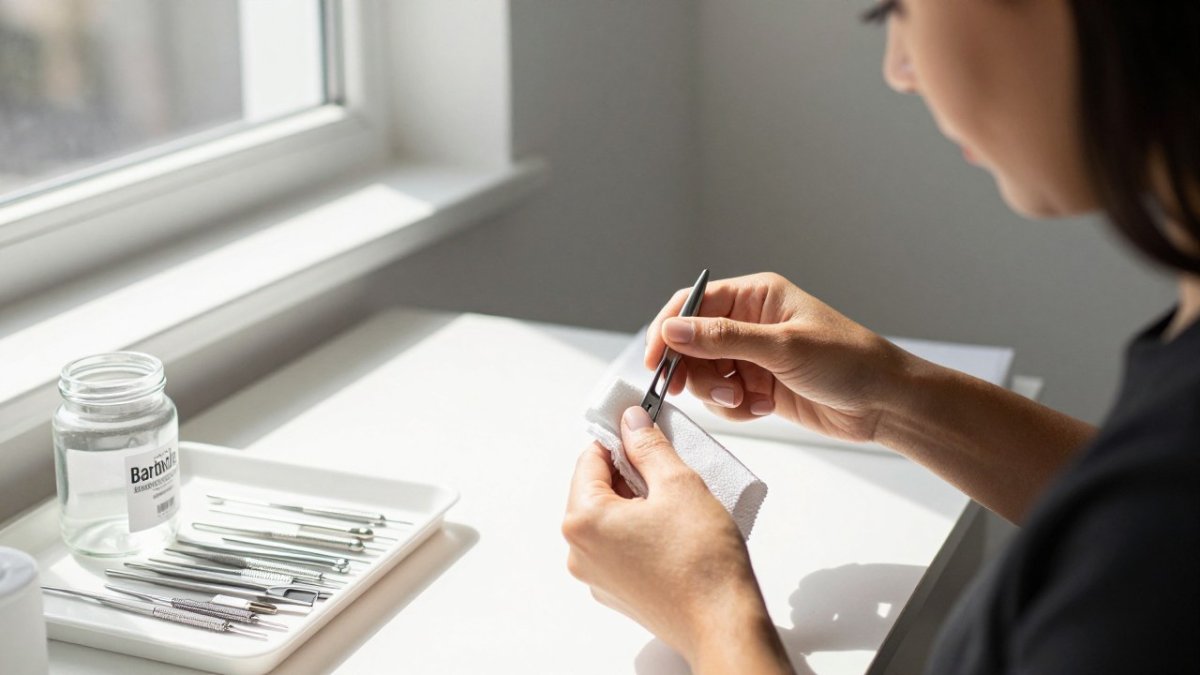
Then look at the tools. Metal implements should come out of a sealed pouch or a covered container, not a drawer. Files and buffers should be new or clearly designated for you. Towels should be clean and stored away from the sink splash zone.
Small details count. A tidy station is easier to keep clean than a cluttered one.
How Nail Salon Disinfection Practices Actually Work
Cleaning and disinfecting are not the same thing, and this is where most confusion starts. Cleaning removes visible debris (the EPA). Disinfection kills most germs on a surface after cleaning (the CDC). Sterilization, which uses heat and pressure, is a step beyond both and is not something a typical nail station does.
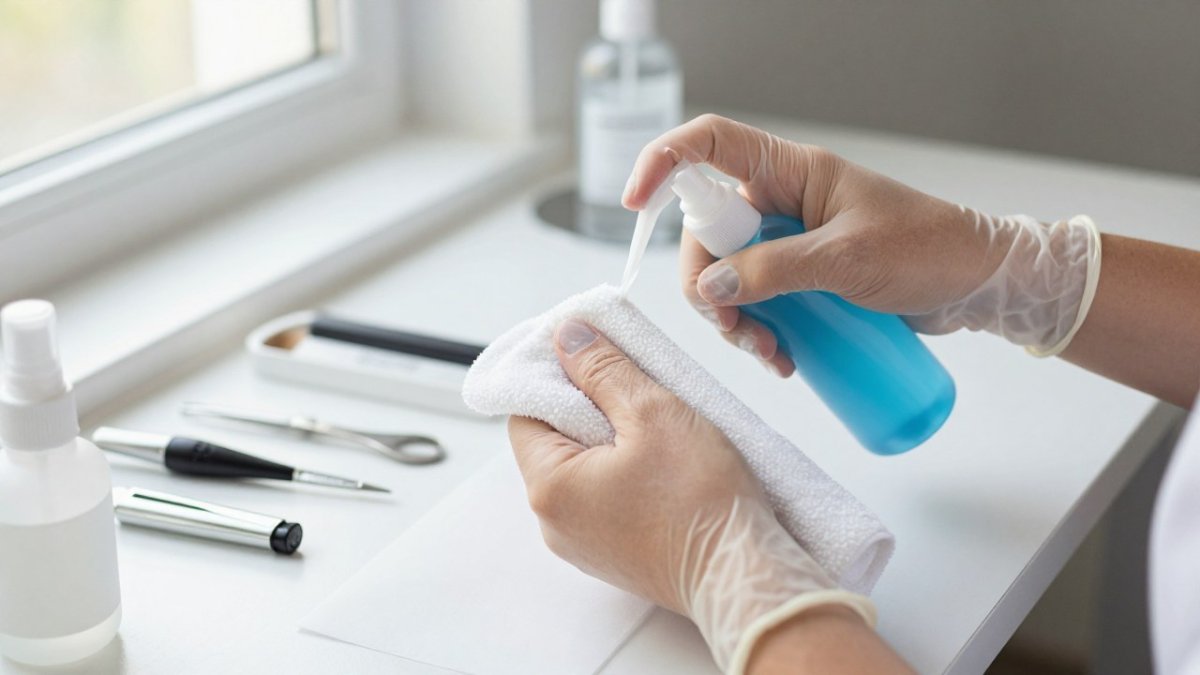
Good nail salon disinfection practices follow a clear order: clean first, then apply an EPA-registered disinfectant, then let it sit for the full contact time on the label. Contact time is the part people skip. A quick wipe isn't disinfection.
How to Verify Disinfectant Use, Not Just Spot the Bottle
Seeing a spray bottle on the counter tells you almost nothing. What matters is whether the product is used the way its label says.
**1. The EPA's guidance on registered disinfectants explains why that number matters: it means the product has been reviewed for the claims on its label.
2. Is it mixed correctly? Many disinfectants are concentrates that must be diluted.
3. Is the contact time being honored? Every disinfectant label lists a wet contact time, the number of minutes the surface must stay visibly wet.
4. Is the solution fresh? Disinfectant solutions lose strength over time and get dirty with use.
5. Is the surface compatible? Some disinfectants are labeled for hard, non-porous surfaces only.
Watch out: a salon can own the right product and still use it wrong.
What "Clean First" Really Means
Disinfectant doesn't work well on top of debris. Implements should be scrubbed with soap and water, dried, and only then placed in the disinfectant. If you see a tool go straight from the table into the jar, that step was skipped.
This is also why a tidy station matters. It's easier to clean and disinfect a surface that isn't buried under clutter, and easier for you to see whether the wipe-down actually happened.
Here are the checks I'd actually make on a salon's disinfection routine, and what each one tells you.
| Check | What to look for | Why it matters |
|---|---|---|
| EPA registration | EPA registration number on the label | Shows product reviewed for its label claims |
| Mixing | Diluted per the label ratio, not by eye | Wrong ratio may be too weak to work |
| Contact time | Surface stays visibly wet for full label time | A quick wipe isn't disinfection |
| Solution freshness | Clear liquid, not cloudy or debris-filled | Solutions lose strength and get dirty with use |
| Surface compatibility | Labeled for hard, non-porous surfaces only | Porous items can't be reliably disinfected |
| Clean first | Scrubbed with soap and water, dried, then soaked | Disinfectant doesn't work well on debris |
Why Single-Use Nail Salon Tools Protect You
Some items simply can't be properly disinfected, and those should be used once and thrown away. Think paper files, buffers, wooden pushers, and anything porous.
Single-use nail salon tools are your best protection against cross-contamination. If a technician reaches for a used file, that's a problem. Fresh files for every client should be the norm, not a nice extra.
Single-use items are a simple way to protect every client.
Salon Sanitation Questions to Ask Without Feeling Awkward
You can ask about sanitation politely, and any professional should welcome it. Try these salon sanitation questions to ask:
- How do you clean and disinfect your tools between clients?
- Which disinfectant do you use, and what's the contact time?
- Do you use fresh files for each client?
- How often do you change towels and linens?
A good technician answers these without flinching. If someone gets defensive, that tells you something too.
Red Flags That Should Make You Pause
Some warning signs are easy to spot once you know them:
- Tools pulled from a drawer with no packaging
- The same file used on the client before you
- A disinfectant jar with cloudy or dirty liquid
- No handwashing between clients
- Strong chemical smells with no ventilation
- Dirty towels stacked near clean ones
Any one of these is worth a question. Several together? I'd think twice.
What to Do If a Salon Fails Your Check
You don't owe anyone an explanation, and you don't have to sit through a service that feels off. But "just leave" isn't always practical mid-appointment, so here is how I'd think through it, from mild to serious.
If It's a Small Issue You Can Name
Sometimes the fix is a simple request. If a technician reaches for a used file, you can say, "Could I get a fresh file?" If the disinfectant jar looks dirty, "Would you mind using a fresh solution?" Most professionals will correct it without a second thought. A good technician answers these without flinching. If someone gets defensive, that tells you something too.
If You Want to Decline the Service
You can stop before the service starts. "I think I'm going to hold off today" is a complete sentence. If you've already paid a deposit or booked online, ask how they'd like to handle it, but you are never obligated to sit through something that concerns you. Trust your gut here.
If You've Already Had the Service
If you notice a problem after the fact, a tool that clearly wasn't fresh, a station that was never wiped, you can still act. Call or email the salon and describe what you saw. A salon that takes sanitation seriously will want to know. If you're not comfortable going back, that's fine too; you can simply choose a different studio next time.
If It's Serious Enough to Report
Some issues go beyond a preference. Reusing single-use items, skipping disinfection entirely, or visible contamination are worth reporting. The tricky part is that salon rules are set at the state and local level, so the right agency depends on where you are.
Here's how to find it:
- Start with your state's cosmetology or barbering board. Most states license salons and technicians through a board, often under a department of licensing or professional regulation. A quick search for your state plus "cosmetology board" will usually get you there.
- Check whether your city or county has its own health department rules. Some localities add their own inspection requirements on top of state licensing.
- Look up the salon's inspection record if it's public. Many licensing boards post inspection results online. Reading them takes a little patience, findings are often written in code or shorthand, but they can tell you whether a concern is a one-off or a pattern.
- Ask what happens next. When you file a complaint, ask whether you'll be contacted and what the timeline looks like. That helps you decide whether to wait or move on.
Watch out: rules vary a lot by jurisdiction, so advice you read online, including mine, may not match your state's requirements. When in doubt, the licensing board is the source that counts.
The Standard to Hold Everyone To
A salon that takes sanitation seriously will happily show you its process. That's a fair standard to hold any studio to. If you decide to switch, this guide on finding a private nail technician near Glendale covers how to vet your next appointment before you book.
Book Your Next Appointment With Confidence
Sanitation isn't a selling point. It's the baseline. When you know what to look for, you can relax and actually enjoy your appointment.
If you'd like a calm, private setting, I'd love to see you. My studio focuses on natural nail health, with structured gel, Gel-X, and restorative pedicures tailored to your nails and routine. See how to book your appointment and find the studio details.
Sanitation is one of those things you only notice when it's missing. If you're ready for an unhurried appointment where clean tools, fresh files, and a properly disinfected station are simply how things work, I'm here. Get started with Central Beauty Studio and book a gel manicure or pedicure that puts your nail health first.
Frequently Asked Questions
How can I tell if a nail salon is sanitary just by looking?
Look for a few visible signs: technicians washing hands or using hand sanitizer between clients, fresh files and buffers taken from a clean drawer, sealed or clearly disinfected tools, and a clean workstation with no dust or leftover debris. You should also see a covered trash can and clean towels. If anything looks reused or dirty, it's fair to ask about their salon sanitation process before your service starts.
What are the most important salon sanitation questions to ask before booking?
Ask how they clean and disinfect reusable tools, whether they use an EPA-registered disinfectant, and how long tools soak. Ask if they use single-use nail salon tools like files and buffers, and how often they change towels and linens. A good technician will answer these calmly and explain their routine. If the answers feel vague or defensive, that tells you something too.
How should reusable nail tools be disinfected between clients?
Reusable tools should be cleaned of visible debris first, then fully submerged in an EPA-registered disinfectant mixed and used according to its label directions, including the required contact time. Tools should be dried and stored in a clean, covered container. Metal implements, drill bits, and reusable files all need this step. Single-use items like paper files and buffers should be thrown away after each client.
What should I do if a salon's sanitation practices make me uncomfortable?
You can politely pause the service and ask a direct question, like how the tools were cleaned or whether the file is fresh. If you still feel uneasy, it's okay to end the appointment early or leave before it begins. Trust your instincts. Your health comes first, and a professional studio should never make you feel bad for asking about nail salon disinfection practices.
